

How We Built a CRM for a UK Construction Company (Case Study)
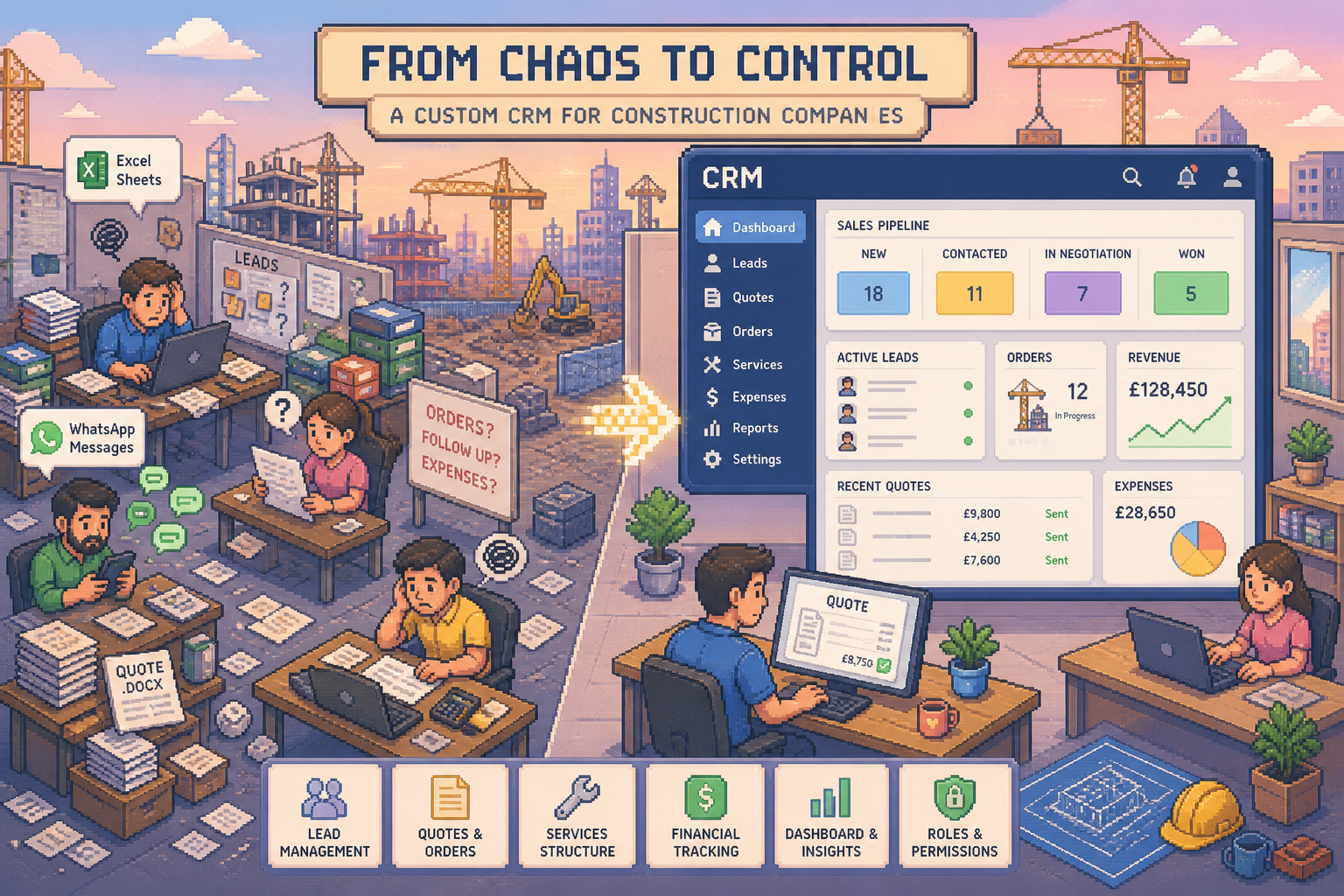
Many construction companies don’t start with structured systems. Instead, they rely on a mix of Excel spreadsheets, WhatsApp messages, and scattered notes. This approach may work in the early stages, but as the business grows, inefficiencies begin to surface.
Leads get lost, follow-ups are missed, quotes take too long to prepare, and there is no clear visibility into ongoing operations. Over time, this lack of structure limits growth and creates unnecessary friction.
This was exactly the situation our UK-based client found themselves in. What they needed was not just a CRM, but a system tailored to the way their business actually operates.
The Problem
Before working with us, their processes were fragmented. Leads were coming in from multiple channels without a structured pipeline to manage them. Sales progress lacked visibility, making it difficult to understand the status of deals at any given time.
Quoting was handled manually, which led to inconsistencies and delays. Once deals were approved, orders were not properly tracked, and there was no unified system connecting revenue with expenses. The business was functioning, but without clarity, control, or scalability.
Our Approach
Rather than jumping straight into development, we began by analyzing how the business truly works. We mapped out their entire operational flow—from lead generation to service delivery and expense tracking.
This gave us a clear structure: Lead → Quote → Order → Service Delivery → Expenses.
The system was then designed around this real-world workflow, ensuring that technology supports the business, not the other way around.
The Solution
We developed a custom CRM and operations platform that acts as a centralized control system for the company.
The sales pipeline was fully customized, allowing leads to move through defined stages such as new, contacted, and in negotiation. Every action is automatically recorded, giving full visibility into who updated a lead, when it was updated, and how long it remained in each stage. We also implemented acquisition tracking to identify where leads originate.
To streamline sales, we built a dedicated quoting system that enables fast and consistent quote generation. Once approved, quotes are seamlessly converted into orders, which are then tracked through their own workflow with full status visibility.
We also introduced a structured service hierarchy, organizing offerings into main services and sub-services. This made it easier to define project scopes clearly and communicate them effectively to clients.
On the financial side, we implemented an expense tracking system that connects operational costs with revenue. This provides a clearer understanding of overall performance and profitability.
A real-time dashboard brings all critical data into one place, including active leads, orders, and revenue insights. Additionally, a granular role and permission system ensures that users only access what is relevant to them, while administrators retain full control.
Technology
The platform was built using Laravel and Filament, providing a modern, scalable foundation. This ensures high performance, flexibility, and the ability to grow alongside the business.
Results
After implementation, the company experienced a significant improvement in operational clarity and efficiency. Lead response times became faster, the sales pipeline became fully visible, and quoting became consistent and structured.
Order tracking improved, and all operations were centralized into a single system. Most importantly, the business transitioned from a reactive, fragmented process to a controlled and scalable operation.
Final Thoughts
Many businesses operate without structured systems longer than they should. While this may work initially, growth inevitably requires clarity and organization.
The key is not adopting generic tools, but building systems that reflect how your business actually functions. That is where real efficiency and long-term scalability come from.
Tags
More Articles
Show All Articles →
Common Mistakes Georgian Companies Make When Hiring Developers
Common mistakes Georgian companies make when hiring developers and how to avoid costly software failures.
What Does a Well-Structured Digital Infrastructure Look Like in a Business?
Learn what a well-structured digital infrastructure looks like and how connected systems, automation, and data flow impr...
Why Some Companies Scale Smoothly While Others Break
Why some companies scale smoothly while others break. Discover how systems, structure, and software impact business grow...