

Why Some Companies Scale Smoothly While Others Break
Growth is often treated as the ultimate sign of success. More customers, more revenue, more activity — all of it seems to point in the right direction.
But growth has a hidden side that many companies don’t anticipate.
As a business expands, complexity increases. What once felt simple becomes harder to manage. Communication slows down, processes become unclear, and small inefficiencies start to compound into larger problems.
At some point, growth stops feeling like progress and starts feeling like pressure.
This is where companies begin to diverge. Some continue growing smoothly, becoming more structured and efficient over time. Others begin to struggle internally, even if they appear successful from the outside.
The difference is not the speed of growth, the market, or even the product.
It’s how the company is built internally.
When Growth Starts to Expose Weaknesses
In the early stages, most businesses operate with a certain level of flexibility. Decisions are quick, communication is direct, and processes are often informal. Teams rely on shared understanding rather than structured systems.
This works — until it doesn’t.
As more clients come in and the team expands, the same informal approach begins to break down. Information becomes harder to track. Tasks require more coordination. Simple actions now depend on multiple people and tools.
What used to take minutes now takes hours. What used to be clear now requires clarification.
These are not dramatic failures. They are small, persistent frictions that slowly disrupt the entire organization.
Over time, they accumulate into something much larger: operational instability.
The Companies That Scale Smoothly
Companies that scale successfully don’t avoid complexity. They accept it early and design around it.
Instead of relying on memory or informal communication, they begin to define how work should happen. Processes become structured, not to create rigidity, but to create clarity.
Workflows are documented, responsibilities are clear, and tasks move through predictable paths. This reduces confusion and allows teams to operate with confidence, even as the company grows.
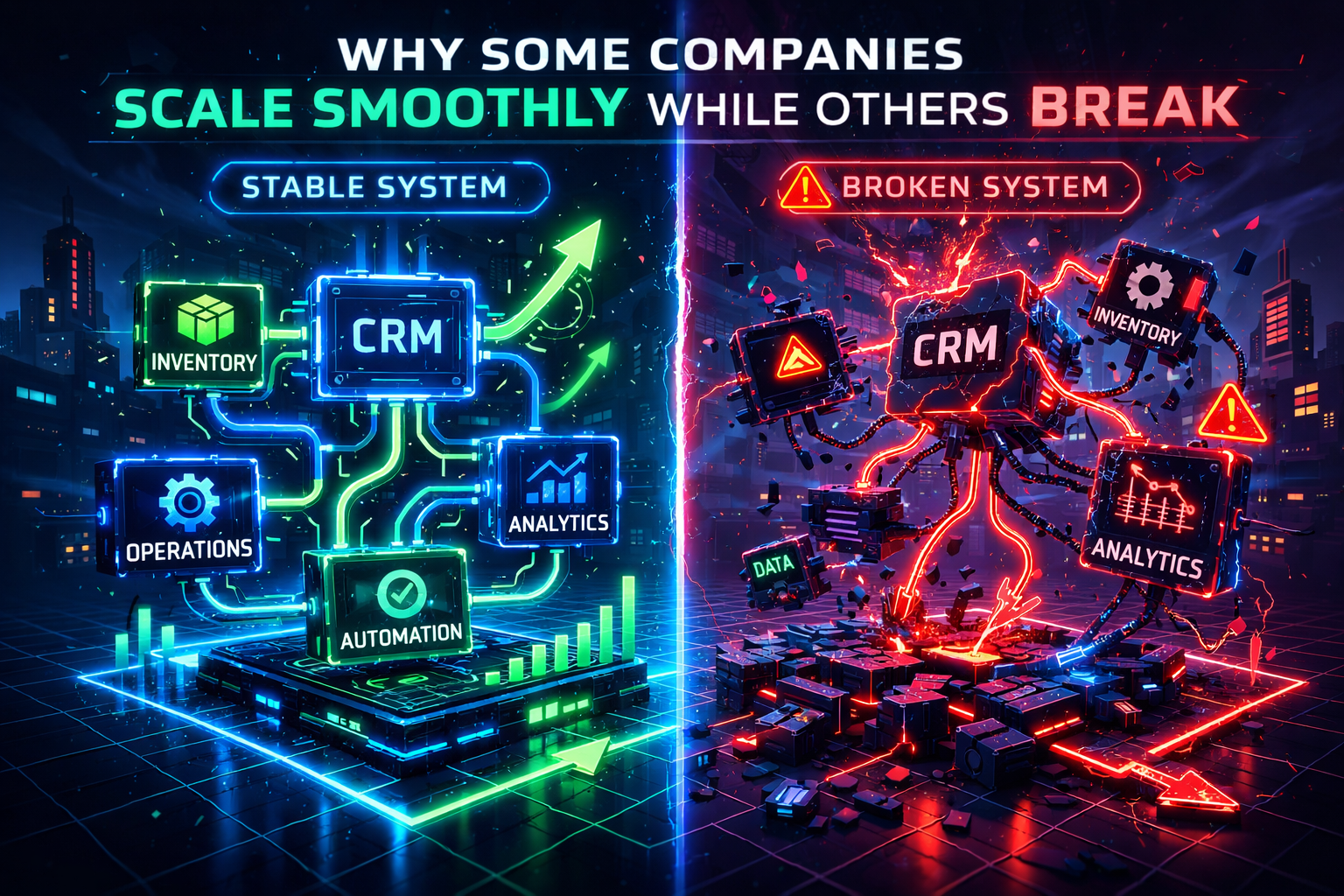
At the same time, these companies invest in connecting their systems. Rather than using tools in isolation, they ensure that information flows between them. Customer data, internal operations, and performance metrics are not scattered — they are part of a connected environment.
This connection changes how the company functions. Employees don’t need to search for information or re-enter the same data multiple times. Systems handle much of the coordination that would otherwise require manual effort.
Another key difference is visibility. In well-structured companies, leadership has access to real-time insights. They don’t rely on assumptions or delayed reports. They can see what is happening across the organization and respond quickly when needed.
Automation also plays an important role. As the volume of work increases, repetitive tasks are gradually removed from human responsibility. Notifications, updates, and reporting processes become automated, allowing teams to focus on more meaningful work.
All of this leads to a structure that can handle growth without collapsing under its own weight.
Why Other Companies Begin to Break
On the surface, companies that struggle with growth often look similar to those that succeed. They may have strong demand, capable teams, and ambitious goals.
The difference becomes visible internally.
Instead of building structure, these companies continue operating as they did in the early stages. They add more tools, more people, and more activity, but without creating alignment between them.
Over time, this leads to fragmentation.
Different teams begin using different systems that don’t communicate with each other. Information becomes inconsistent, and employees spend more time trying to understand what is happening than actually doing their work.
Manual processes start to dominate. Important tasks depend on individuals remembering what needs to be done. Communication becomes reactive rather than structured.
Without clear processes, each team — and often each person — develops their own way of working. This creates inconsistency and increases the likelihood of mistakes.
Perhaps most critically, there is no single source of truth. Data exists in multiple places, often with conflicting values. As a result, decision-making becomes slower and less reliable.
Leaders are forced to rely on partial information, intuition, or outdated reports. This delays responses and makes it harder to navigate growth effectively.
The Moment That Changes Everything
There is usually a point where the strain becomes impossible to ignore.
It often comes during periods of rapid expansion — when new clients are coming in quickly, the team is growing, and operations are becoming more complex.
At this stage, the company faces a choice.
It can continue operating in the same way, hoping to manage the increasing complexity through effort alone. Or it can recognize that growth requires a different approach and begin building the systems and structure needed to support it.
This decision is rarely dramatic, but its consequences are significant.
Companies that invest in structure begin to stabilize and scale. Those that don’t often find themselves overwhelmed, regardless of how much opportunity is in front of them.
The Role of Software in Scaling
Software is often misunderstood as just a tool — something that helps perform specific tasks.
In reality, it plays a much deeper role in growing businesses.
Well-designed systems create the foundation for structure. They define how information flows, how processes are executed, and how different parts of the organization interact with each other.
Instead of relying on manual coordination, companies can rely on systems that enforce consistency and reduce friction.
Software connects operations, centralizes data, and enables automation. It transforms scattered activities into a coherent structure.
In this sense, software is not just supporting growth. It is shaping how that growth happens.
Conclusion
The difference between companies that scale smoothly and those that struggle is not always visible from the outside.
Internally, however, the contrast is clear.
One operates through structure, clarity, and connected systems. The other relies on effort, improvisation, and fragmented tools.
Growth amplifies whatever foundation a company has.
If that foundation is strong, growth becomes an opportunity. If it is weak, growth becomes a source of pressure.
In the end, companies don’t break because they grow too fast.
They break because they were not built to handle the growth they achieved.
Tags
More Articles
Show All Articles →
How We Built a CRM for a UK Construction Company (Case Study)
Custom CRM for a UK construction company: streamline leads, quotes, orders, and finances with a system built for real wo...

Common Mistakes Georgian Companies Make When Hiring Developers
Common mistakes Georgian companies make when hiring developers and how to avoid costly software failures.
What Does a Well-Structured Digital Infrastructure Look Like in a Business?
Learn what a well-structured digital infrastructure looks like and how connected systems, automation, and data flow impr...