

How Companies Build Their Internal Digital Ecosystem
In many modern companies, the most important technology is the part customers never see.
Behind every website, product, or service exists a complex network of internal systems that coordinate operations, store information, and automate daily workflows. These systems form what can be described as a company’s internal digital ecosystem.
When built well, this ecosystem becomes the operational backbone of the organization. It allows teams to work faster, reduces manual work, and gives leadership clear insight into how the business is performing.
However, companies rarely start with such a structure. Most digital ecosystems evolve gradually as businesses grow and their operational needs become more complex.
The Beginning: Simple Tools for Simple Problems
In the early stages, companies typically rely on a small collection of basic tools.
Spreadsheets track customer data. Email becomes the main communication channel. Accounting software manages finances. Project management tools help organize tasks.
At first, this setup works surprisingly well. Small teams can easily adapt and move information between systems manually. Because the company is still relatively small, the lack of integration does not create major problems.
But growth changes everything.
As the number of customers increases and teams expand, information begins to spread across multiple platforms. Data may exist in several different places, and employees often spend time searching for the most accurate version.
Gradually, the simple system that once supported the business begins to create friction.
When Growth Creates Complexity
As organizations expand, their operations become more complicated.
More customers mean more transactions, support requests, and sales activities. Larger teams require stronger coordination between departments. New services introduce additional workflows that must be tracked and managed.
When internal systems remain disconnected, employees often find themselves repeating the same tasks across different platforms. Data must be copied manually from one tool to another. Reports require collecting information from multiple sources.
These inefficiencies may seem small individually, but across an entire organization they consume a significant amount of time.
At this point, many companies begin to realize they need something more structured than a collection of independent tools.
They begin thinking about building an integrated digital ecosystem.
Understanding the Digital Ecosystem Concept
An internal digital ecosystem is not a single software platform.
Instead, it is a network of interconnected systems that manage different parts of the company while sharing data with one another.
In this environment, information flows naturally between departments.
A new customer created in the sales system can automatically appear in the billing platform. Project management tools can update operational dashboards in real time. Financial data can feed directly into reporting systems used by leadership.
Rather than operating as isolated tools, the systems become part of a coordinated digital infrastructure.
The result is a more organized and efficient organization where information is accurate, accessible, and continuously updated.
The Core Systems Inside a Business Ecosystem
Although every company structures its ecosystem differently, most internal digital environments revolve around several core system categories.
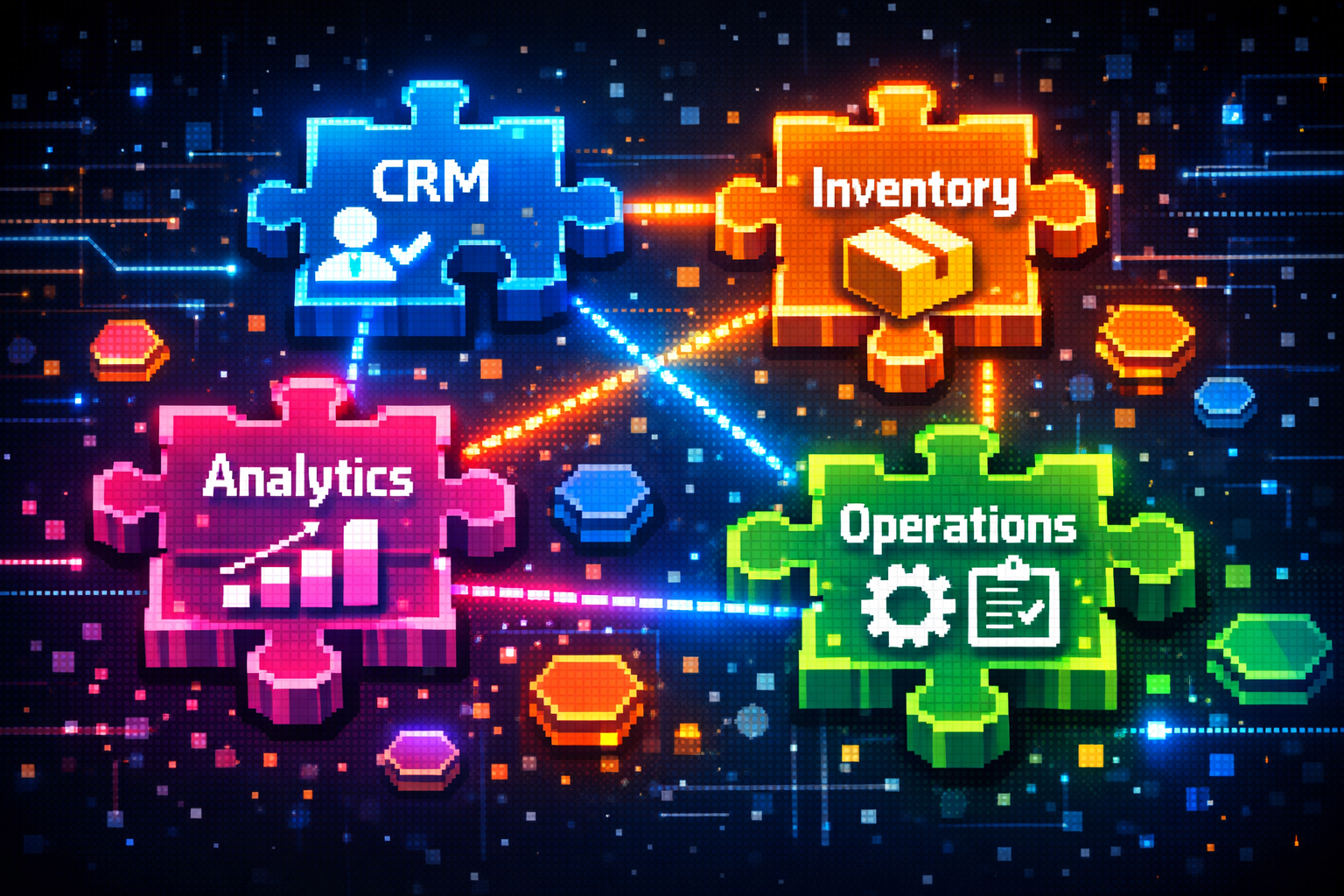
Customer systems manage relationships with clients. These platforms track leads, sales activity, contracts, and communication history. Because customer data drives many business processes, these systems often sit at the center of the ecosystem.
Operational systems support the day-to-day work of teams. Project management platforms, workflow tools, and internal collaboration systems help coordinate tasks across departments and ensure that projects move forward efficiently.
Financial systems track the economic side of the organization. Invoices, payments, expenses, and financial reports provide the data needed to monitor business performance.
Finally, analytics and reporting systems transform raw data into insights. Dashboards allow leaders to track key metrics, identify trends, and make informed strategic decisions.
Together, these systems form the digital infrastructure that supports the company’s operations.
Integrations: The Glue Between Systems
The true power of a digital ecosystem comes from integration.
Modern software platforms often provide APIs or integration tools that allow them to communicate with other systems. These connections enable data to move automatically between platforms without manual input.
For example, when a new customer signs up for a service:
-
The sales system records the new client
-
The billing platform generates the invoice
-
The project management tool creates onboarding tasks
-
The analytics dashboard updates performance metrics
All of this can happen instantly through system integrations.
Automation builds on this foundation. Routine processes—such as sending notifications, generating reports, or assigning tasks—can run automatically in the background.
This not only improves efficiency but also reduces the risk of human error.
When Businesses Build Custom Platforms
As companies continue to grow, many eventually encounter a new challenge: generic software can only go so far.
Even when tools are integrated, they may not perfectly match the company’s unique workflows. Teams may still need to adapt their processes to fit the limitations of existing platforms.
At this stage, some organizations begin developing custom internal platforms.
These platforms allow companies to design software specifically around their operations. Instead of juggling multiple tools, teams may access a centralized system that combines customer management, operational workflows, reporting, and communication.
Although custom development requires planning and investment, it often provides long-term advantages for organizations with complex processes.
Why Digital Ecosystems Matter
A well-designed digital ecosystem provides more than technical convenience. It fundamentally improves how a company operates.
Efficiency improves because employees spend less time performing repetitive administrative work.
Transparency increases because connected systems provide a clear, real-time view of operations.
Scalability becomes easier because systems can handle larger volumes of data, customers, and workflows.
And perhaps most importantly, decision-making improves because leaders have access to accurate and timely information.
In many organizations, operational performance is directly linked to the strength of the systems supporting it.
Building an Ecosystem Takes Time
Digital ecosystems rarely appear overnight.
Most companies build them gradually as new challenges arise and operations expand. Systems are added, integrations are created, and workflows are refined step by step.
What starts as a handful of disconnected tools slowly evolves into a coordinated digital infrastructure.
Organizations that approach this process thoughtfully often discover that their internal operations become significantly more efficient, structured, and scalable.
Conclusion
Every successful modern company relies on technology that works quietly in the background.
While customers interact with products, services, and websites, internal teams rely on a network of systems that manage information, coordinate workflows, and automate routine tasks.
This network—the internal digital ecosystem—is what allows businesses to operate efficiently and grow sustainably.
Companies that invest in building and improving these ecosystems gain a powerful advantage: technology that not only supports their operations, but actively enables their growth.
Tags
More Articles
Show All Articles →
How We Built a CRM for a UK Construction Company (Case Study)
Custom CRM for a UK construction company: streamline leads, quotes, orders, and finances with a system built for real wo...

Common Mistakes Georgian Companies Make When Hiring Developers
Common mistakes Georgian companies make when hiring developers and how to avoid costly software failures.
What Does a Well-Structured Digital Infrastructure Look Like in a Business?
Learn what a well-structured digital infrastructure looks like and how connected systems, automation, and data flow impr...