


Managing Change During Digital Transformation: Why Technology Isn’t the Hard Part

Digital transformation is often framed as a technology initiative: selecting platforms, integrating systems, migrating data, and automating workflows. But in practice, technology is the predictable part. The real uncertainty lies in how people respond to new ways of working.
Organizations rarely fail because software doesn’t function. They fail because teams do not fully adopt it, managers revert to familiar processes, or leadership underestimates the operational friction caused by change. Digital transformation is, at its core, a behavioral and organizational shift enabled by technology—not driven by it alone.
Technology Changes Fast. Organizational Habits Do Not.
Every system embeds assumptions about how work should be done. When a company introduces a new ERP, CRM, or internal platform, it is not simply replacing a tool—it is redefining workflows, ownership, accountability, and decision-making speed.
This creates natural resistance, even in high-performing teams. Employees who were previously efficient may feel temporarily incompetent. Managers may lose visibility into processes they once controlled manually. Informal workarounds that evolved over years suddenly disappear.
This resistance is not irrational. It reflects operational risk from the perspective of those responsible for delivering results. Ignoring this reality is one of the most common reasons digital initiatives stall after deployment.
Successful organizations treat resistance as data, not as an obstacle. It reveals where workflows are unclear, where training is insufficient, and where systems do not align with operational reality.
Clarity of Purpose Determines Adoption
People do not resist change without reason. They resist change that appears arbitrary, poorly justified, or disconnected from real problems.
Transformation must be anchored in concrete operational outcomes. For example:
-
Reducing reporting time from days to minutes
-
Eliminating duplicate manual data entry
-
Improving accuracy of operational or financial reporting
-
Enabling faster, more confident decision-making
When teams understand the specific problems being solved, adoption becomes rational rather than forced.
Leadership must communicate not only what is changing, but why it matters operationally. Vague goals such as “modernization” or “innovation” do not drive adoption. Operational clarity does.
Involvement Creates Ownership. Ownership Drives Adoption.
One of the most consistent predictors of successful transformation is early involvement from the people who will use the system daily.
When systems are designed in isolation—by external consultants, IT departments, or senior leadership—they often reflect theoretical workflows rather than actual operational complexity. This results in friction, inefficiencies, and eventual workarounds.
In contrast, involving operational teams early creates two advantages:
First, systems align better with real workflows.
Second, psychological ownership emerges. People are more likely to adopt systems they helped shape.
Transformation shifts from being perceived as an imposed disruption to a jointly built improvement.
Implementation Is a Technical Milestone. Adoption Is the Business Outcome.
Many organizations treat deployment as the finish line. In reality, deployment is only the beginning of the transformation phase.
A system that exists but is inconsistently used creates fragmentation rather than efficiency. Teams may revert to spreadsheets, parallel tracking, or informal communication channels. This undermines data integrity and eliminates the intended strategic value.
Adoption requires structured enablement:
-
Practical, role-specific training—not generic demonstrations
-
Immediate operational relevance—showing how daily work improves
-
Accessible support during early usage phases
-
Leadership reinforcement through consistent usage expectations
Adoption accelerates when new systems demonstrably reduce effort, increase clarity, or improve outcomes—not simply because they exist.
Phased Rollouts Reduce Operational and Psychological Risk
Large-scale, simultaneous deployments introduce unnecessary risk. They overwhelm teams, expose multiple unknowns at once, and increase the probability of operational disruption.
Phased rollouts allow organizations to validate assumptions in controlled environments. Early phases generate practical insights, expose gaps, and allow refinement before scaling.
Equally important, early successes build organizational confidence. Momentum reduces resistance more effectively than directives.
Transformation becomes evidence-driven rather than assumption-driven.
Post-Launch Monitoring Reveals the Reality of Transformation
Transformation success cannot be measured by system availability. It must be measured by system usage.
Key indicators include:
-
Frequency and consistency of system use
-
Reduction in manual or parallel processes
-
Accuracy and completeness of data
-
Speed and confidence of operational decision-making
These indicators reveal whether transformation is embedded into operational reality or exists only at a technical level.
Organizations that actively monitor and refine systems post-launch extract significantly more value from their investments.
Change Management Is an Operational Capability, Not a Support Function
Organizations that consistently succeed in digital transformation treat change management as a core operational discipline.
They recognize that:
-
Technology enables change, but people execute it
-
Adoption determines return on investment
-
Transformation is an ongoing process, not a one-time event
These organizations build internal capability to manage change deliberately. As a result, each subsequent transformation becomes faster, less disruptive, and more effective.
Over time, the ability to adapt becomes a structural advantage.
Digital transformation does not succeed because technology is deployed. It succeeds because organizations evolve how they operate.
Tags
More Articles
Show All Articles →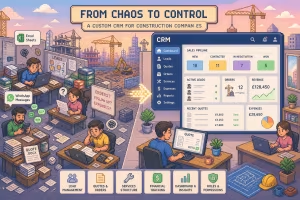
How We Built a CRM for a UK Construction Company (Case Study)
Custom CRM for a UK construction company: streamline leads, quotes, orders, and finances with a system built for real wo...

Common Mistakes Georgian Companies Make When Hiring Developers
Common mistakes Georgian companies make when hiring developers and how to avoid costly software failures.

What Does a Well-Structured Digital Infrastructure Look Like in a Business?
Learn what a well-structured digital infrastructure looks like and how connected systems, automation, and data flow impr...