
From Business Idea to Scalable Platform
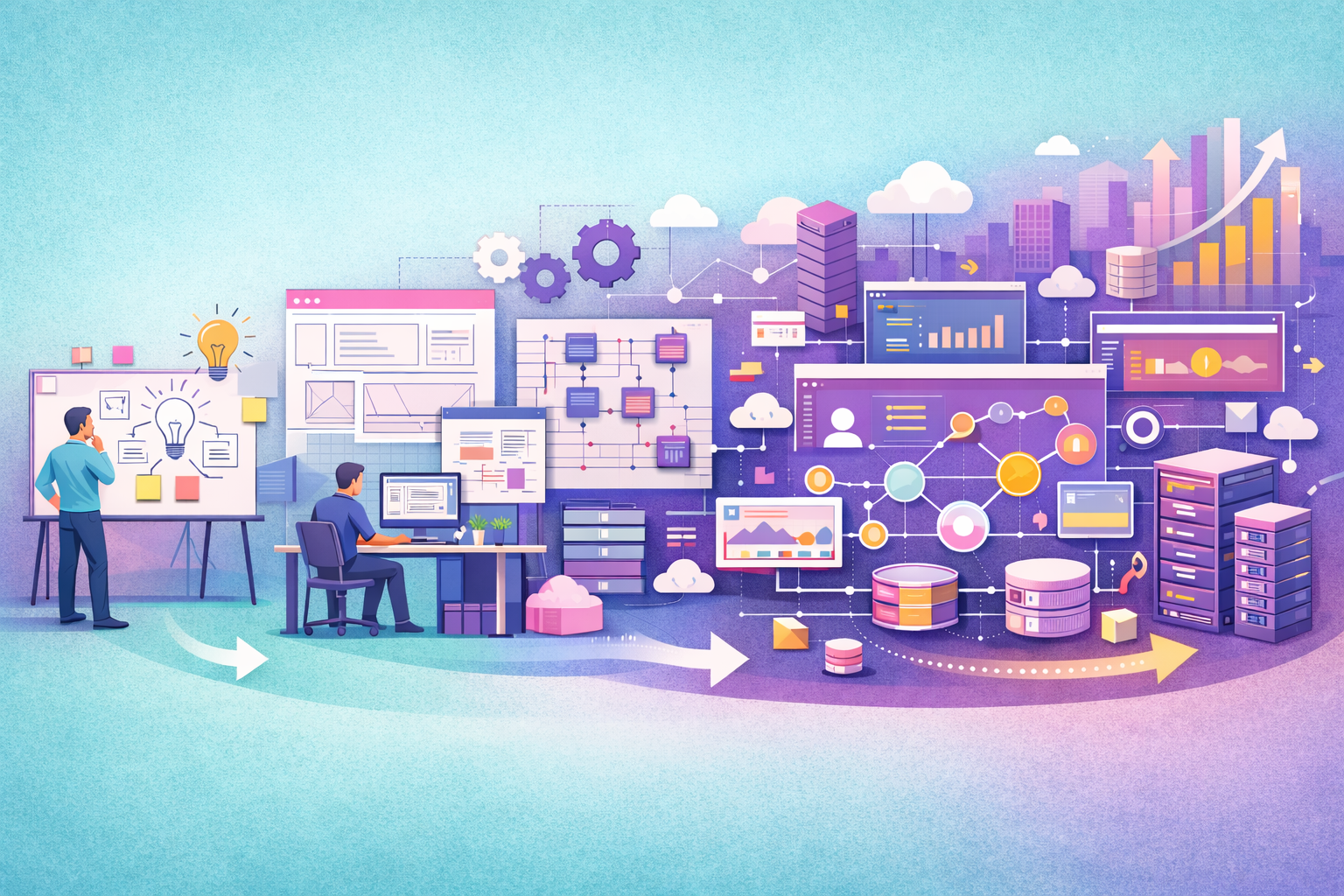
Many businesses begin with a strong idea—a service that solves a problem, improves efficiency, or creates new value. However, turning that idea into a scalable digital platform requires far more than development alone. Successful platforms emerge from a structured process that combines business clarity, technical planning, and continuous evolution. Scalability is not something added later. It is designed from the very beginning.
This article outlines the key stages required to transform a business idea into a stable, scalable platform capable of supporting long-term growth.
Start With the Problem, Not the Product
The most successful platforms are built to solve a clearly defined and validated problem. Without this foundation, development risks focusing on features that do not deliver real value.
Before writing code, businesses must identify their target users, understand their needs, and define the specific use cases the platform will support. This process includes validating demand, analyzing alternatives in the market, and confirming that the proposed solution addresses a genuine gap or inefficiency.
A common mistake is feature-driven thinking—building functionality because it seems useful rather than because it directly solves the core problem. This leads to unnecessary complexity, increased costs, and slower time to market.
Great platforms begin with clarity. When the problem is well understood, every technical and product decision becomes more focused and effective.
Defining the Minimum Viable Product (MVP)
An MVP is not a simplified version of the final product. It is a strategic tool designed to validate assumptions and prove value as early as possible.
The goal of an MVP is to deliver the core functionality that allows users to achieve the primary purpose of the platform. It should exclude secondary features, advanced automation, and non-essential enhancements that do not directly contribute to validating the business model.
Prioritizing core value allows businesses to launch faster, gather real-world feedback, and reduce risk. Early user interaction reveals how the platform is actually used, which assumptions are correct, and what improvements are needed.
Launching quickly does not mean sacrificing structure or quality. A well-built MVP is designed with future growth in mind, even if it initially includes only essential features.
The purpose of the MVP is learning, validation, and establishing a foundation for expansion.
Choosing the Right Architecture From Day One
Technical architecture plays a critical role in long-term scalability. Decisions made early in development directly affect performance, flexibility, and the ability to grow.
Platforms built without scalability in mind often encounter limitations as user numbers increase. These limitations can result in slow performance, system instability, and costly rebuilds.
A scalable platform is designed with modular architecture. This allows components to be improved, replaced, or expanded without affecting the entire system. Clear separation between the user interface, business logic, and data layer ensures flexibility and maintainability.
Avoiding technical debt is also essential. Short-term shortcuts may accelerate initial development, but they often create long-term constraints that are expensive and disruptive to fix later.
Scalability is not an upgrade. It is an architectural decision made at the foundation stage.
Building With Growth in Mind
A scalable platform must handle increasing users, higher transaction volumes, and expanding data without compromising performance or reliability.
This requires careful infrastructure planning, including database design, server architecture, and system resource management. Performance optimization ensures fast response times, while reliability planning minimizes downtime and system failures.
Security is another critical component. As platforms grow, they handle more sensitive data and become more visible targets. Proper authentication, access control, and data protection mechanisms must be built into the system from the beginning.
Integration readiness is also important. Scalable platforms often need to connect with third-party services, payment providers, analytics tools, and internal systems. Designing flexible integration capabilities early prevents limitations later.
A well-built platform grows smoothly. It supports expansion without requiring fundamental restructuring.
Aligning Technology With Business Strategy
Technology alone does not create a successful platform. It must directly support business goals, revenue models, and operational workflows.
Monetization strategies—such as subscriptions, transaction fees, or service-based pricing—must be reflected in system functionality. Operational processes, including user management, reporting, and internal workflows, must be supported by the platform’s design.
Data strategy is equally important. Platforms generate valuable insights about user behavior, performance, and operational efficiency. Proper data collection and analytics enable informed decision-making and continuous improvement.
Key performance indicators (KPIs) help measure growth, user engagement, and system effectiveness. These metrics guide both business and technical decisions.
Technology should function as an enabler of business success, not as an isolated technical asset.
Continuous Iteration and Optimization
A platform is not finished at launch. Launch is the beginning of an ongoing process of improvement and evolution.
User feedback provides critical insights into usability, performance, and missing functionality. Real-world usage often reveals opportunities and challenges that were not visible during development.
Data-driven improvements allow businesses to refine workflows, optimize performance, and enhance the user experience. Over time, platforms evolve to support new features, integrations, and operational needs.
Continuous iteration ensures that the platform remains aligned with business growth and changing market conditions.
Successful platforms are built in stages, with each stage strengthening the foundation and expanding capabilities.
Building a Scalable Platform Requires More Than Development
Transforming a business idea into a scalable platform requires a combination of business understanding, technical expertise, and structured execution.
It requires:
-
Clear definition of the problem and users
-
Strategic MVP development
-
Scalable and flexible technical architecture
-
Infrastructure designed for growth
-
Alignment between technology and business goals
-
Continuous improvement based on real-world feedback
This process is not a one-time project. It is an ongoing partnership between business and technology, focused on creating a stable, scalable foundation for long-term success.
Platforms that follow this approach are not only able to launch successfully—they are able to grow, adapt, and support the business for years to come.
More Articles
Show All Articles →
How We Built a CRM for a UK Construction Company (Case Study)
Custom CRM for a UK construction company: streamline leads, quotes, orders, and finances with a system built for real wo...

Common Mistakes Georgian Companies Make When Hiring Developers
Common mistakes Georgian companies make when hiring developers and how to avoid costly software failures.

What Does a Well-Structured Digital Infrastructure Look Like in a Business?
Learn what a well-structured digital infrastructure looks like and how connected systems, automation, and data flow impr...