
How Automation Changes Decision-Making, Not Just Speed

When businesses talk about automation, the conversation almost always starts with speed. Faster workflows. Faster responses. Faster execution.
But speed is only the surface-level benefit.
The real transformation happens deeper — in how decisions are made, who makes them, and when they’re made. Automation doesn’t just help teams move faster; it fundamentally reshapes the way a business thinks and operates.
Speed Solves Symptoms. Decisions Shape Outcomes.
Manual processes slow things down, but they also hide problems.
When teams rely on spreadsheets, emails, and memory, decisions are often:
-
Reactive instead of proactive
-
Based on partial information
-
Influenced by whoever speaks the loudest
-
Made too late to matter
Automation doesn’t just accelerate work — it changes the conditions under which decisions happen.
Automation Replaces Guesswork With Visibility
In manual environments, decision-making is often built on assumptions:
-
“I think sales are doing fine”
-
“It feels like this process is working”
-
“We’ll notice if something goes wrong”
Automation introduces real-time visibility:
-
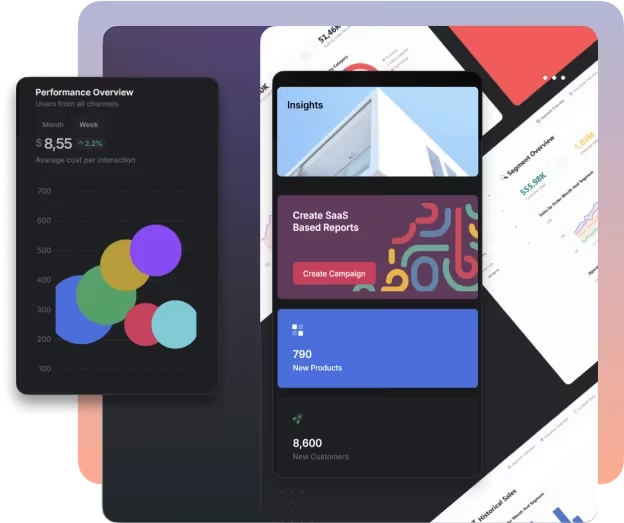
Live dashboards instead of monthly reports
-
Status-based workflows instead of verbal updates
-
Clear ownership instead of shared responsibility
When data becomes visible and reliable, decisions shift from instinct to insight.
Decisions Move From Individuals to Systems
In many growing businesses, decisions live in people’s heads:
-
One manager knows how approvals really work
-
One employee remembers critical steps
-
One founder approves everything manually
This creates bottlenecks and risk.
Automation forces decisions to be:
-
Documented
-
Rule-based
-
Repeatable
-
Transparent
Instead of asking “What should we do here?” every time, the system already knows — and acts accordingly.
Automation Changes When Decisions Are Made
One of the biggest hidden benefits of automation is timing.
Manual processes detect problems late:
-
After deals are lost
-
After clients complain
-
After revenue drops
Automated systems detect signals early:
-
Stalled leads
-
Delayed tasks
-
Unusual behavior patterns
-
Process bottlenecks forming in real time
This allows businesses to shift from damage control to early intervention.
Less Emotional Decision-Making
Human-driven processes are emotional by nature:
-
Urgent emails create panic
-
Loud problems get attention
-
Quiet failures go unnoticed
Automation introduces neutrality.
Rules don’t panic.
Triggers don’t forget.
Dashboards don’t exaggerate.
This creates a calmer, more rational decision-making environment where:
-
Priorities are clearer
-
Trade-offs are visible
-
Actions are consistent
Automation Reveals Structural Problems
Manual systems often hide inefficiencies because people compensate for them.
Automation removes that safety net.
When a process breaks under automation, it doesn’t mean automation failed — it means the process was never solid to begin with. This exposure is valuable because it forces leadership to:
-
Redesign workflows
-
Clarify ownership
-
Eliminate unnecessary steps
-
Align teams around reality, not assumptions
Leaders Shift From Managing Tasks to Managing Systems
Without automation, leaders spend time:
-
Following up
-
Checking statuses
-
Asking for updates
-
Fixing avoidable mistakes
With automation in place, leadership focus shifts to:
-
Optimizing workflows
-
Interpreting data
-
Improving strategy
-
Anticipating risks
Decision-making becomes strategic instead of operational.
Automation Creates Decision Consistency
One overlooked benefit of automation is fairness and consistency.
When processes are automated:
-
Every lead is treated the same
-
Every client follows the same onboarding logic
-
Every approval follows the same rules
This removes variability caused by mood, fatigue, or bias — and builds trust both internally and externally.
Speed Is the Outcome, Not the Goal
Yes, automation makes businesses faster.
But speed is a byproduct of something more important:
-
Better visibility
-
Earlier signals
-
Clearer rules
-
Stronger systems
-
Smarter decisions
Businesses that focus only on speed miss the real advantage. Businesses that focus on decision quality build operations that scale naturally.
Conclusion
Automation doesn’t replace human judgment — it elevates it.
By removing noise, delay, and ambiguity, automation creates an environment where better decisions happen more often, earlier, and with less stress.
In the long run, the businesses that win are not the fastest ones —
they’re the ones that decide better.
And automation, when done right, is one of the most powerful tools for making that happen. 🚀
Tags
More Articles
Show All Articles →
How to Measure Success in Digital Transformation
How to measure digital transformation success using real business metrics like efficiency, data quality, decision-making...

Turning Business Data Into a Competitive Advantage
Learn how businesses can turn data into a competitive advantage through better decisions, automation, analytics, and str...

The Moment Automation Stops Being Optional
When automation stops being optional: learn the signs that manual processes hit their limit and why systems are essentia...