
The Customer Data Your Business Is Collecting But Never Using
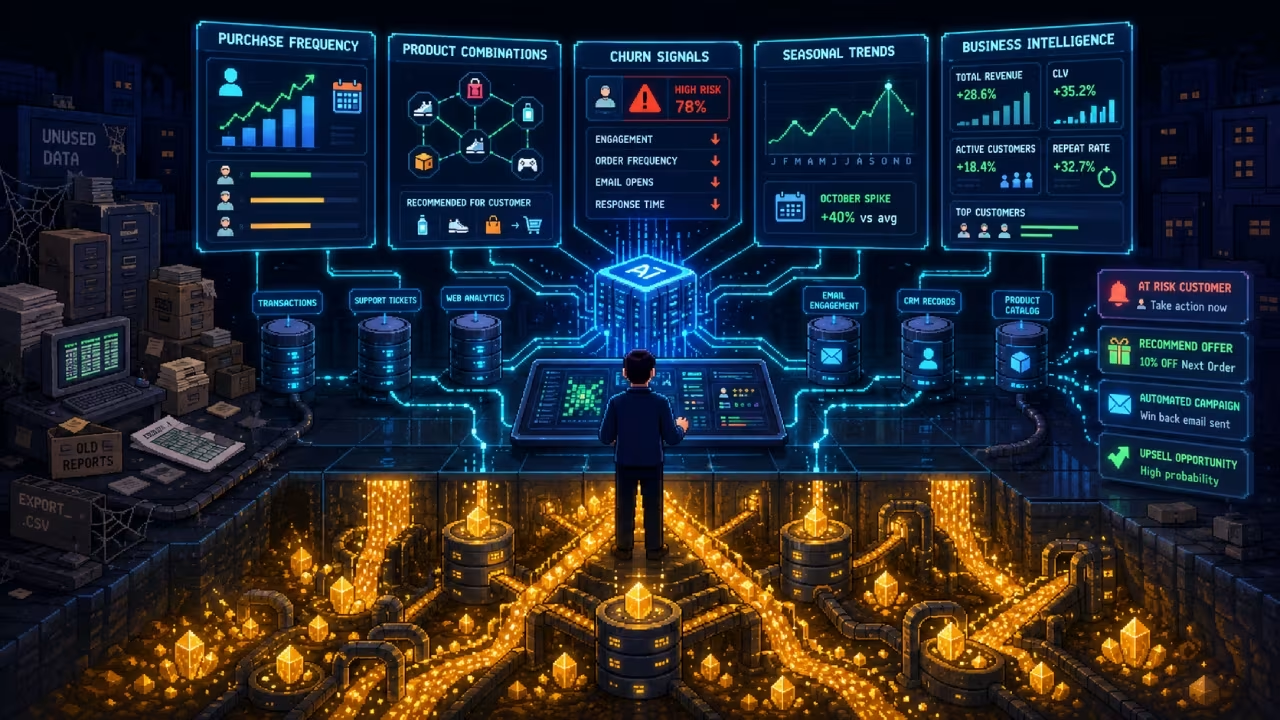
Your business is sitting on a goldmine. You just haven't started mining it.
Every transaction, every interaction, every support request, every abandoned cart, every repeat purchase — your systems are recording all of it. Quietly. Continuously. Without anyone asking them to stop.
The problem isn't the data. The problem is that for most businesses, that data goes exactly nowhere. It accumulates in databases, ages in spreadsheets, and gets summarized into a single monthly revenue figure that tells you almost nothing useful about what's actually happening with your customers.
Here's what's already in your systems — and what you could be doing with it.
Purchase Frequency: Who's Loyal and Who's Drifting
Your system knows exactly when each customer last bought from you, how often they buy, and whether that frequency is increasing or decreasing over time.
Most businesses never look at this. They treat all active customers as equally healthy until one of them stops buying entirely — at which point it's usually too late to do anything about it.
Purchase frequency data tells a different story in real time. A customer who used to order monthly and hasn't ordered in 47 days isn't lost yet — but they're drifting. A customer whose order frequency has doubled over six months is a candidate for a loyalty offer or an upsell conversation.
When you segment customers by purchase frequency and track how that changes over time, you stop managing customers as a group and start managing them as individuals. The ones who need attention become visible before they disappear.
Product Combinations: The Upsell Map You Never Drew
Every time a customer buys product A and product B together, your system records it. Every time someone buys C without ever buying D — even though D would logically complement it — that's recorded too.
This is your upsell map. And almost nobody uses it.
Product combination data tells you which items are natural pairs, which products are entry points that lead to larger purchases, and which items customers consistently buy separately when they'd be better served buying together. It tells you what to recommend, what to bundle, and what to put in front of a customer based on what they've already chosen.
A business using this data doesn't guess at cross-sell opportunities. It reads them directly from customer behavior and acts on them systematically — through automated recommendations, targeted follow-up, or a sales rep who walks into a conversation already knowing what to suggest.
Seasonal Patterns: Stop Being Surprised Every Year
Your business has seasons. Every business does — even ones that don't think of themselves as seasonal. There are months when certain products move faster, periods when customer acquisition slows, times of year when support requests spike.
Your historical data contains all of this. And yet most businesses are surprised by their own patterns every single year — understaffed in busy months, overstocked in slow ones, unprepared for the demand surge they could have seen coming simply by looking at the same period twelve months earlier.
Seasonal pattern analysis turns hindsight into foresight. When you know that March is always 40% stronger than February, you staff accordingly. When you know that a specific product category spikes in October, you stock accordingly. You stop reacting to your own business and start anticipating it.
Churn Signals: The Warning Your Data Is Already Sending
This is the most valuable — and most ignored — data your business collects.
Customers rarely leave without warning. Before they cancel, stop ordering, or go to a competitor, their behavior changes. They contact support more. They order less. They stop opening your emails. They take longer to respond. They ask questions they never asked before.
These are churn signals, and they are already in your data. A customer whose engagement has dropped 60% over 90 days is not a lost customer yet — they are a recoverable one, if you reach them in time.
Businesses that track churn signals systematically catch customers in the drift phase, not the departure phase. A well-timed call, a targeted offer, or simply an acknowledgment that you've noticed — these interventions work when deployed early. They rarely work after the customer has already decided to leave.
The Data Is There. The System to Use It Is What's Missing.
None of what's described above requires new data collection. It requires connecting the data you already have, structuring it properly, and building the reporting layer that surfaces what matters.
The gap between a business that uses its customer data and one that doesn't isn't a data gap. It's a systems gap.
Your customers are already telling you everything you need to know. The question is whether your business is listening.
Insights Consulting builds custom data systems, CRM integrations, and business intelligence tools that turn existing operational data into actionable insight. Let's talk about your data.
Tags
More Articles
Show All Articles →
The Real Reason Georgian Businesses Resist Software Investment
Why Georgian businesses hesitate to invest in software, why their concerns are valid, and how to choose the right ERP, C...
How to Use Your CRM to Predict Next Month's Revenue
Learn how to use your CRM to forecast next month's revenue with weighted pipelines, stage velocity, and smarter sales pl...

The Hidden Costs of Cheap Software Development
Cheap software often leads to rewrites, bugs, and high long-term costs. Learn the hidden risks and how to choose the rig...