
How Automation Reduces Operational Risks
Operational risk is one of the most underestimated threats to growing businesses. While companies focus on revenue, marketing, and expansion, risks embedded in daily operations often go unnoticed. Missed tasks, incorrect data, unclear responsibilities, and inconsistent execution gradually undermine performance. As organizations scale, these vulnerabilities multiply. Automation plays a critical role in reducing operational risk by introducing structure, consistency, and visibility into business processes.
Understanding Operational Risk
Operational risk refers to failures caused by weaknesses in internal processes, systems, or human actions. Common examples include manual data entry errors, delayed approvals, lost information, duplicated work, compliance violations, and communication breakdowns between teams.
In early stages, these risks may appear manageable. However, as transaction volumes increase and operations become more complex, manual coordination becomes unreliable. When businesses depend on individuals to remember tasks, update spreadsheets correctly, or communicate progress informally, operational stability becomes fragile and unpredictable.
Reducing Human Error Through Structured Workflows
Human error is one of the primary sources of operational risk. Manual data entry, copy-pasting information between systems, and unstructured workflows increase the likelihood of mistakes.
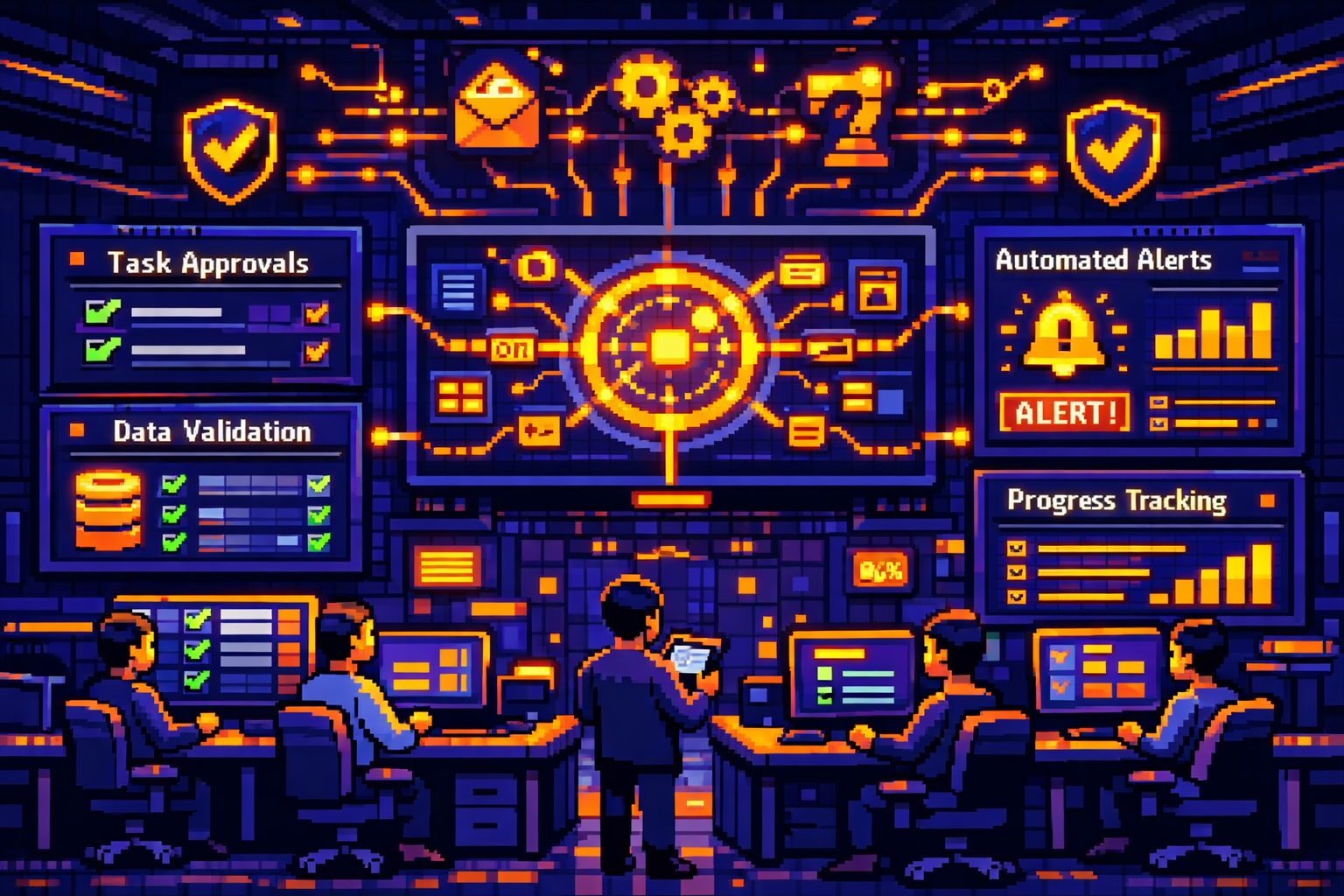
Automation reduces these risks by enforcing predefined workflows, validation rules, and standardized data inputs. Required steps cannot be skipped. Data formats remain consistent. Notifications and task assignments are triggered automatically.
This structured execution significantly improves accuracy and prevents failures caused by oversight, inconsistency, or incomplete processes.
Increasing Process Stability and Visibility
Automated systems create predictable and controlled workflows. Each task follows a defined sequence, with clear ownership and status tracking. Managers gain real-time visibility into operational progress, allowing them to identify delays, bottlenecks, or failures early.
This transparency reduces reliance on informal communication and manual follow-ups. Every action is logged, creating a traceable history that improves accountability and enables continuous process improvement.
As a result, operations become more stable, measurable, and manageable.
Improving Data Reliability and Decision Confidence
Fragmented tools and manual record-keeping often lead to inconsistent or outdated information. This creates significant operational and financial risk.
Automation centralizes data within structured systems, creating a single source of truth. Updates occur in real time, ensuring that all teams work with accurate and consistent information.
Reliable data reduces reporting errors, improves compliance, and enables faster, more confident decision-making. Leaders can act based on verified information rather than assumptions or incomplete records.
Supporting Growth Without Increasing Risk
As businesses grow, operational complexity increases. More customers, transactions, and internal dependencies introduce additional points of failure. If processes remain manual, risk grows alongside scale.
Automation allows organizations to manage higher operational volumes without proportional increases in coordination overhead or error rates. Standardized workflows ensure consistent execution regardless of scale.
By digitizing and structuring operations early, companies build resilience and prevent risk from expanding with growth.
Automation as a Core Risk Management Strategy
Automation is not only an efficiency tool. It is a foundational risk management strategy. It strengthens operational control by enforcing process consistency, improving visibility, and ensuring data reliability.
Businesses that invest in automation reduce operational uncertainty and create a stable foundation for growth. Instead of relying on individual effort to maintain order - they rely on systems designed to ensure predictable execution.
In competitive markets, operational stability is a strategic advantage. Automation enables organizations to scale confidently while maintaining control, accuracy, and reliability across their operations.
Tags
More Articles
Show All Articles →
Connecting CRM with Your Website: The Benefits of Seamless Integration
Connect your CRM with your website to sync data, automate workflows, improve accuracy, boost sales and create a seamless...

Chatbots and CRM: Smarter Customer Interactions
How integrating Chatbots transforms customer communication. Automation, data, and AI improves customer experience, boost...

AI Content for SEO: What You Need to Know
Discover how AI-generated content impacts SEO. Learn the key benefits, potential risks, and best practices for creating...